

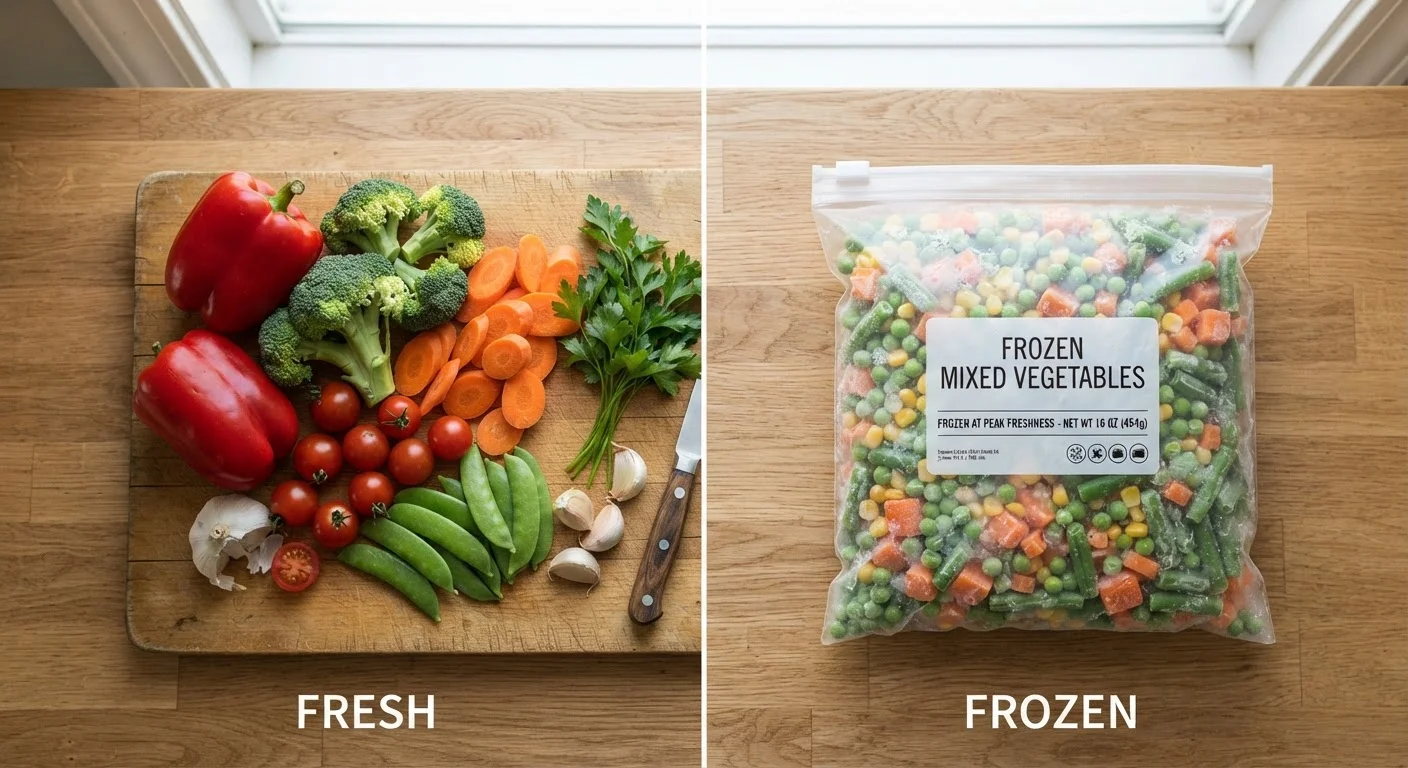
Option A
Fresh Produce
The conventional choice with familiar appeal.
Best for: Shoppers who cook frequently, live near good markets, or need produce for raw preparations where texture matters.
Option B
Frozen Produce
The underestimated option that punches above its weight.
Best for: Budget-focused households that want to reduce food waste, stock up strategically, and maintain consistent nutrient intake year-round.
Where the Nutrition Debate Actually Stands
The assumption that fresh automatically beats frozen is widespread — and largely unsupported by the evidence. Research published in journals including the Journal of Agricultural and Food Chemistry has found that frozen vegetables frequently match or exceed their fresh counterparts in key vitamins, particularly water-soluble ones like vitamin C and folate.
Here's why: most frozen produce is harvested at peak ripeness and processed within hours. That rapid blanching and freezing locks in nutrients before degradation can occur. Fresh produce, by contrast, often travels hundreds of miles over several days before reaching a store shelf — and then may sit in your refrigerator for several more days. During that time, nutrient content drops measurably. Studies have found that some fresh vegetables can lose 15–50% of certain vitamins within days of harvest, depending on storage conditions.
This doesn't mean fresh produce is nutritionally poor. It means the gap between fresh and frozen is much smaller than marketing and intuition suggest, and in some cases it runs in frozen's favor. Eating well on a tight budget starts with understanding myths like this one.
| Criterion | Fresh Produce | Frozen Produce |
|---|---|---|
| Nutrient retention | High if eaten quickly after harvest | High; locked in at peak ripeness |
| Cost per serving | Varies; often higher | Generally lower |
| Shelf life | Days to one week | Several months |
| Food waste risk | Higher | Lower |
| Texture for raw use | Excellent | Not suitable |
| Texture for cooked use | Good | Good to excellent |
| Seasonal availability | Dependent on season and region | Year-round consistency |
| Flavor at peak season | Superior | Good |
The Cost and Waste Equation
Nutrition aside, the financial case for frozen produce is straightforward. Frozen vegetables typically cost less per serving than fresh, and they eliminate one of the biggest quiet drains on a food budget: spoilage. The USDA has estimated that American households waste roughly 30–40% of the food supply, and fresh produce is a major contributor.
A bag of frozen spinach bought today can still be used three months from now. A bunch of fresh spinach needs to be eaten within days or thrown away. For smaller households or anyone who doesn't cook every day, that shelf-life difference translates directly into dollars saved.
Frozen produce also makes it easier to keep a consistent variety of vegetables in the house year-round, regardless of what's in season locally. If you want to go deeper on using your freezer strategically, making the most of a small freezer covers storage, rotation, and what actually holds up well after freezing.
30–40%
US food supply lost to waste
According to USDA estimates, American households discard a substantial share of the food they purchase, with fresh produce among the top contributors.
Up to 50%
Vitamin loss in fresh produce post-harvest
Research has found that certain water-soluble vitamins in fresh vegetables can decline significantly within just a few days of harvest depending on storage and transit conditions.
~$1,500
Annual food waste cost per household
The Natural Resources Defense Council has estimated that the average American family loses roughly this amount each year to discarded food.
When Fresh Is the Right Call
Frozen produce has real limits. The blanching process — brief heat exposure before freezing — softens vegetable cell walls. That's fine for cooked applications like soups, stir-fries, or casseroles, but it means frozen produce won't work for salads, crudités, or dishes where a crisp texture is essential.
Fresh also wins on flavor when produce is genuinely in season and locally sourced. A tomato bought in August from a farmer's market is a different experience from a tomato bought in January, whether fresh or frozen. For peak-season cooking, fresh local produce is hard to beat on both taste and nutrient density.
Timing matters too. If you buy fresh produce with a clear plan to use it within a day or two, you're getting it at its best. The problem is that most of us don't always cook on schedule — which is where frozen becomes the smarter default. Seasonal produce calendars can help you identify when fresh makes the most financial and culinary sense throughout the year.
Building a Practical Strategy for Both
The most sensible approach isn't to pick a side — it's to use each option where it performs best. Keep a core supply of frozen staples (peas, corn, edamame, spinach, broccoli) for cooked dishes and quick meals. Buy fresh produce for raw applications and when something is genuinely in season and affordable. Store-brand frozen vegetables are also worth considering — in this category, the quality difference from name brands is often negligible.
One useful habit: before buying fresh produce, ask yourself when you realistically plan to use it. If you're not sure, frozen is the lower-risk choice. And if you find yourself buying in volume, bulk buying trade-offs are worth thinking through before you commit.
This article is for general informational purposes only and does not constitute nutritional, medical, or financial advice. Individual dietary needs vary — consult a registered dietitian or qualified professional for guidance tailored to your situation.
The content provided on our blog site traverses numerous categories, offering readers valuable and practical information. Readers can use the editorial team’s research and data to gain more insights into their topics of interest. However, they are requested not to treat the articles as conclusive. The website team cannot be held responsible for differences in data or inaccuracies found across other platforms. Please also note that the site might also miss out on various schemes and offers available that the readers may find more beneficial than the ones we cover.