

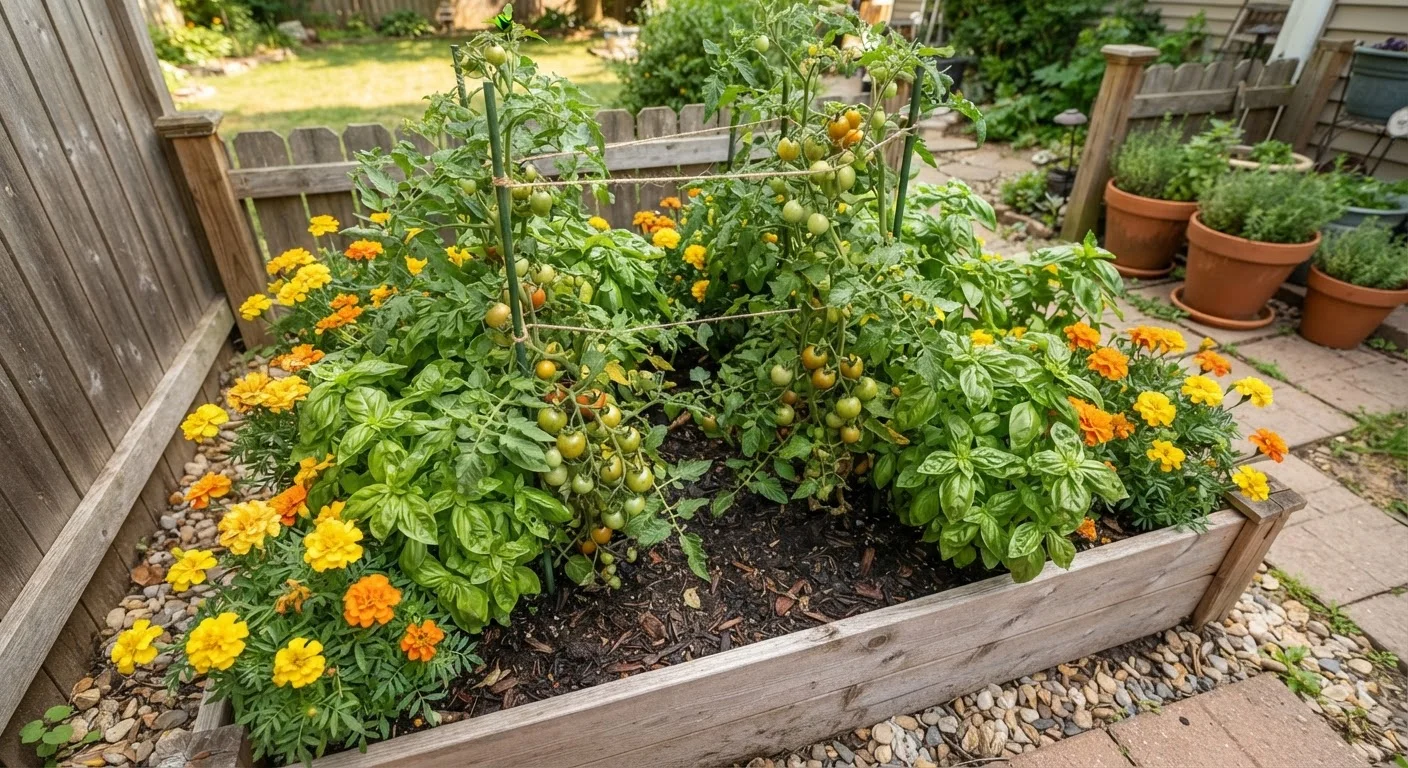
The Basic Idea: Plants That Help Each Other
Companion planting is essentially strategic neighborliness in the garden. Instead of growing crops in isolated rows or sections, you position plants near others that offer some practical advantage — whether that's deterring insects, loosening compacted soil, shading out weeds, or simply filling space that would otherwise go unused.
The concept predates modern agriculture. Indigenous farming traditions in North America developed the 'Three Sisters' system — corn, beans, and squash planted together — as a remarkably effective polyculture. Corn provides a vertical structure for beans to climb; beans fix atmospheric nitrogen into a form the soil (and corn) can use; squash spreads low along the ground, blocking weeds and retaining soil moisture. Each plant contributes something the others benefit from.
That's the core logic: different plants have different strengths and needs, and positioning them intentionally can create a system that functions better than any single crop grown alone.
Treat Claims About Companion Planting Critically
Gardening folklore contains many companion planting claims that have not been rigorously tested. Planting basil near tomatoes to repel whitefly, for example, is a widely repeated tip with limited controlled evidence. This doesn't mean the practice is harmful — but it does mean you should treat unverified pairings as experiments rather than guarantees. The strongest evidence supports nitrogen-fixing legumes, nematode suppression via marigolds, and beneficial insect attraction via flowering herbs.
What Companion Planting Can Realistically Do
It's worth separating the well-documented benefits from the more speculative ones — not to dismiss companion planting, but to help you use it wisely.
- Nitrogen fixation: Legumes (beans, peas, clover) form a relationship with soil bacteria that converts nitrogen from the air into soil-available nutrients. Planting them near heavy feeders like corn or leafy greens is one of the most substantiated benefits in companion planting.
- Pest deterrence: Marigolds (Tagetes species) are shown in research to suppress certain soil nematodes. Dense plantings of aromatic herbs may confuse or deter some flying pests by masking the chemical signals crops emit — though results vary significantly by pest species and garden conditions.
- Attracting beneficial insects: Flowers like dill, fennel, and alyssum attract predatory wasps and other insects that feed on common garden pests. This is a reliable and well-supported mechanism.
- Space efficiency: Pairing tall plants with low-growing or sprawling ones allows you to layer the canopy and produce more per square foot — a major advantage in tight gardens.
For gardens where every square foot matters, companion planting pairs naturally with space-efficient planting strategies that squeeze maximum yield from minimal ground.
Putting It Into Practice in a Small Garden
You don't need a half-acre plot to use companion planting effectively. Most of the practical benefits scale down to raised beds, containers, and balcony gardens without losing much.
A few practical starting points:
- Plant basil near tomatoes. While the pest-repellent evidence is modest, basil and tomatoes share similar growing conditions — they're both warm-season, sun-loving plants. Growing them together is at minimum space-neutral, and many gardeners report fewer aphid clusters anecdotally.
- Edge beds with marigolds. A border of French marigolds around a vegetable bed provides documented nematode suppression and attracts pollinators. They're also inexpensive from seed and visually appealing.
- Interplant fast and slow crops. Radishes and lettuce mature quickly; pair them with slower crops like peppers or eggplant to use space that would otherwise sit empty while the main crop establishes.
- Add a flowering herb near every bed. Dill, cilantro allowed to bolt, or a single borage plant can act as a beneficial insect magnet that serves the whole garden.
If you're working entirely in containers, companion planting still applies. A pot with basil, a cherry tomato, and a trailing nasturtium is both productive and a natural pest-confusing environment. See our guide to container gardening in rental spaces for setup ideas that don't require permanent changes.
Pairing companion planting with good soil care amplifies results. Our article on composting at home covers how to build the kind of soil that makes all these plant relationships perform better. And once you know what you're growing together, a seasonal planting calendar will help you time each pairing correctly across the growing year.
“The soil is the great connector of lives, the source and destination of all. It is the healer and restorer and resurrector, by which disease passes into health, age into youth, death into life. Without proper care for it we can have no community, because without proper care for it we can have no life.”
— Wendell Berry, Author and agricultural advocate, from 'The Unsettling of America'
Frequently Asked Questions
Some pairings are well supported by research — legumes genuinely fix nitrogen that neighboring plants can use, and certain flowers do attract beneficial insects. Other popular claims, like tomatoes repelling aphids via basil proximity, have weaker scientific backing. Treating companion planting as a helpful tool with variable results, rather than a guaranteed fix, sets realistic expectations.
The 'Three Sisters' combination of corn, beans, and squash is one of the most documented pairings in agricultural history. Marigolds planted near vegetables are shown to deter certain nematodes. Legumes like peas or beans near nitrogen-hungry plants like leafy greens or corn provide a soil benefit backed by solid science.
Yes. Many companion planting strategies translate well to containers and raised beds. Pairing herbs like basil with vegetables in the same planter, or placing a pot of marigolds next to edibles, can deliver some of the same benefits at a micro scale. Space efficiency is actually one of companion planting's strongest advantages.
Some plants do inhibit each other's growth — a concept called allelopathy. Fennel, for example, is widely noted to suppress growth in many nearby plants and is generally kept separate. Onions and beans are another commonly cited incompatible pair. These effects aren't always dramatic, but they're worth factoring into your layout.
No. Companion planting requires no special equipment, sprays, or purchases — just thoughtful placement of plants you'd likely grow anyway. It's one of the genuinely zero-cost strategies available to home gardeners working with limited budgets.
The content provided on our blog site traverses numerous categories, offering readers valuable and practical information. Readers can use the editorial team’s research and data to gain more insights into their topics of interest. However, they are requested not to treat the articles as conclusive. The website team cannot be held responsible for differences in data or inaccuracies found across other platforms. Please also note that the site might also miss out on various schemes and offers available that the readers may find more beneficial than the ones we cover.