

Our Verdict
Meal planning edges out purely flexible shopping for most budget-conscious households because it directly attacks the two biggest food-budget leaks: waste and unplanned purchases. That said, a rigid plan can backfire if it ignores sales or leads to meals you won't actually cook. The most cost-effective approach for most people is a hybrid — plan the framework, stay open to substitutions.
| Best for | Recommended |
|---|---|
| Households with a predictable weekly schedule | Structured meal planning |
| Confident cooks who shop sales and use up what they buy | Flexible shopping |
| Most budget-conscious millennials in practice | Hybrid approach — loose plan, flexible execution |
| Anyone struggling with food waste or overspending | Structured meal planning as a starting point |
What We Mean by Each Approach
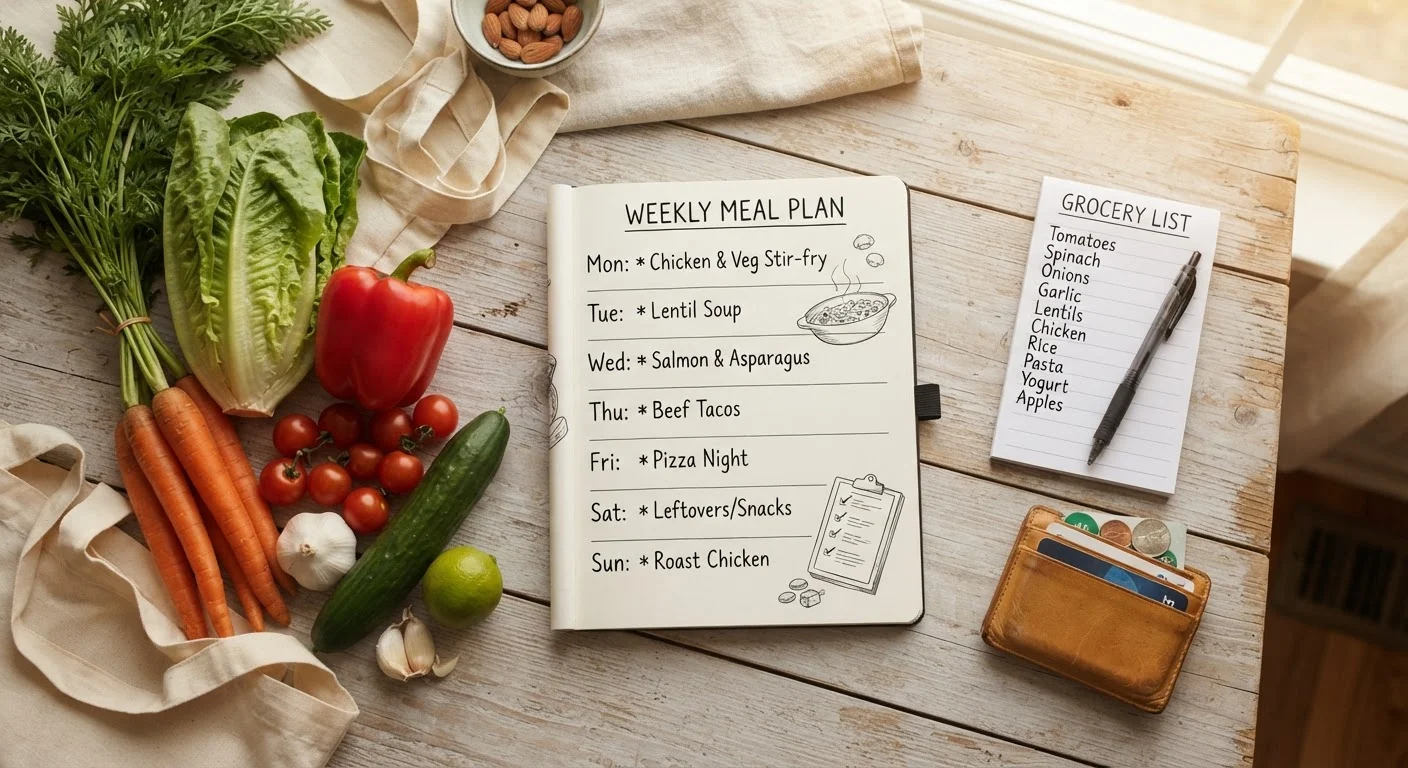
Structured meal planning means deciding what you'll eat for the week before you shop — writing out dinners (and often lunches), then building your grocery list from that plan. Nothing goes in the cart that isn't tied to a specific meal or a known staple.
Flexible shopping means heading to the store with a general sense of what you need, buying what looks good or is on sale, and figuring out meals from there. At its best, this approach lets you chase markdowns and avoid wasting money on ingredients you planned to use but didn't. At its worst, it's how a $60 shopping trip turns into $90 with nothing coherent to cook.
Neither approach is inherently right. But they perform very differently depending on your habits — and understanding that gap is where the real savings opportunity lives. For a deeper look at how your shopping habits affect the bill, see common grocery habits that quietly drain your budget.
Where Meal Planning Saves — and Where It Doesn't
The core financial advantage of meal planning is control. When you know exactly what you need, you're less likely to buy duplicates, forget you already have something, or grab extras "just in case." You also go into the store with a list, which research consistently links to lower total spend.
Meal planning also reduces food waste dramatically. Produce and proteins bought for specific recipes actually get used. That matters because wasted food is effectively money thrown away — it's one of the largest controllable costs in a household food budget.
The downside: a rigid plan can be expensive if it ignores what's actually on sale that week. Planning chicken thighs when whole chickens are half price, or buying bell peppers off-season, costs you money a flexible shopper might avoid. A plan built around seasonal produce and pantry staples closes most of this gap.
| Meal Planning | Flexible Shopping | |
|---|---|---|
| Upfront time required | 30–60 min weekly to plan and list | Minimal — shop as you go |
| Food waste | Lower — ingredients tied to specific meals | Higher — unplanned items often go unused |
| Impulse spending | Lower — list keeps focus | Higher — no list, more temptation |
| Ability to chase sales | Limited unless plan is built around sales | Strong — buy whatever is discounted |
| Works well for | Busy schedules, families, budget newcomers | Confident cooks, flexible schedules |
| Risk of overspending | Low if plan is followed | High without strong discipline |
Where Flexible Shopping Wins — and Where It Falls Apart
Flexible shopping has a real edge for people who genuinely cook intuitively. If you can look at a marked-down pork shoulder and know exactly how to use it across three meals, you're capturing value a rigid planner misses. The same goes for clearance produce: an experienced cook turns it into soup or stir-fry; an inexperienced one lets it rot.
The problem is that most people overestimate how disciplined they are without a plan. Without a list, it's easy to buy ingredients that don't combine into actual meals, grab convenience items to fill gaps, or skip a shopping trip and order delivery instead. Those decisions are where flexible shopping quietly becomes the more expensive option.
If you want the flexibility to work with what's already on hand, planning meals around what's already in your kitchen is a practical middle ground worth exploring.
The Hybrid That Works for Most People
In practice, the most cost-effective approach for most households isn't purely one or the other. A loose weekly framework — three to five planned dinners, a standard lunch rotation, and a short staples list — gives you enough structure to avoid waste and impulse buys while leaving room to swap proteins based on what's marked down or use up whatever produce needs to go.
This hybrid also reduces the mental load that makes rigid meal planning hard to sustain. You're not locked into Tuesday's salmon if the store is out or the price spiked. You have a plan, not a contract.
For those looking to build this kind of system from scratch, a complete framework for low-budget meal planning walks through each step. And if you're curious whether meal planning deserves a more permanent place in your financial habits — not just your cooking routine — this piece on meal planning as a financial habit makes the case clearly.
Start With Just Three Planned Dinners
If full weekly meal planning feels like too much, commit to planning just three dinners before you shop. That's enough structure to anchor your list and cut impulse buys, while leaving room for leftovers, takeout nights, or whatever's marked down mid-week. Small structure beats no structure when it comes to keeping the grocery bill predictable.
This article is for general informational purposes only and does not constitute financial or dietary advice. Individual results will vary based on household size, local grocery prices, and personal habits.
The content provided on our blog site traverses numerous categories, offering readers valuable and practical information. Readers can use the editorial team’s research and data to gain more insights into their topics of interest. However, they are requested not to treat the articles as conclusive. The website team cannot be held responsible for differences in data or inaccuracies found across other platforms. Please also note that the site might also miss out on various schemes and offers available that the readers may find more beneficial than the ones we cover.