

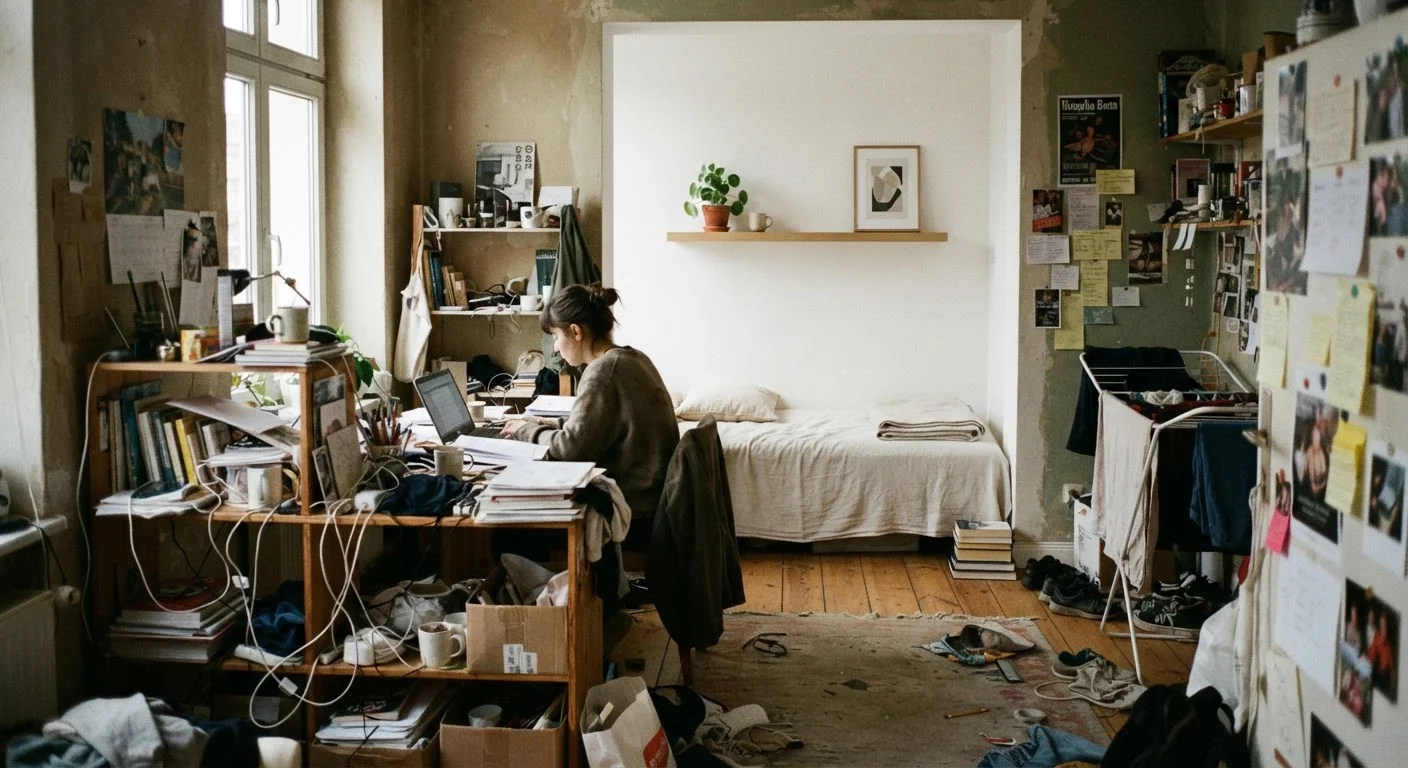
How Your Brain Reads a Room
Every time you walk into a space, your brain performs a rapid environmental scan. It maps exits, estimates distances, identifies objects, and assesses whether the scene is safe and navigable. This happens automatically — and it consumes real cognitive resources. In a spacious, orderly room with clear sightlines, the process is fast and low-effort. In a small, cluttered room, it isn't.
The human visual system is not designed to ignore information. Every object in view is evaluated, even briefly. In a compact apartment loaded with items on counters, floors, and shelves, the brain is running that evaluation loop almost continuously. Researchers studying attentional fatigue — the depletion of directed attention — have found that visually dense environments accelerate this drain considerably.
This is why clutter doesn't just feel messy. It feels heavy. And in a small space, where there is less open wall, floor, and surface area to provide visual breathing room, the cognitive weight compounds quickly. For a broader vocabulary to describe what's happening in compact living environments, see the complete reference to small-space living concepts.
The Cortisol Connection: Stress Hormones and Home Environments
The link between cluttered homes and physiological stress has been examined in academic settings. A frequently cited study published in the journal Personality and Social Psychology Bulletin found that women who described their homes using words associated with clutter and unfinished projects had higher levels of cortisol — the body's primary stress hormone — throughout the day compared with those who described their homes as restful or restorative.
Cortisol fluctuations tied to the home environment are significant because the home is where most people expect to recover from external stressors. When the domestic environment is itself a source of cortisol elevation, the usual recovery cycle is disrupted. Over time, this can contribute to a chronic low-grade stress state that affects sleep, concentration, and mood.
↑ Cortisol
Elevated stress hormones in cluttered homes
A study in Personality and Social Psychology Bulletin found women in high-clutter homes had higher cortisol profiles throughout the day compared with those in tidy, restorative-feeling homes.
~⅓
Recommended negative space in a room
Interior design practitioners commonly reference the guideline that roughly one-third of a room's visual field should remain unoccupied to support a feeling of calm and spaciousness.
11%
Productivity reduction in cluttered workspaces
Research from Princeton University Neuroscience Institute suggested that physical clutter in a person's environment competed for neural representation, reducing the brain's ability to focus and complete tasks.
Small spaces intensify this dynamic. In a studio apartment or a one-bedroom shared between multiple occupants, there are fewer rooms to retreat to and less physical separation between the cluttered and the calm. The stress-generating environment is also the bedroom, the kitchen, and the living room simultaneously.
Visual Noise and the Concept of Negative Space
Interior designers use the term visual noise to describe the cognitive interference caused by too many competing elements — colours, textures, shapes, and objects — in a single field of view. Just as auditory noise makes concentration harder, visual noise taxes the brain's filtering systems and reduces the subjective sense of peace in a space.
The antidote is negative space: intentional emptiness. A clear stretch of wall, an uncluttered countertop, or an open section of floor gives the eye a place to rest and the brain a moment of low-demand processing. In small-space design, negative space is not wasted space — it is a functional tool for managing cognitive load.
This concept directly informs decisions like whether to use open shelving or closed cabinets in a kitchen. Open shelves put everything in constant view, increasing visual complexity; closed cabinets conceal it. The trade-offs between open shelving and closed cabinets in small kitchens are worth examining carefully with this psychological lens in mind.
Designing for Calm on a Tight Budget
Understanding the psychology is useful. Acting on it without spending heavily is the challenge most renters and small-space dwellers actually face. The good news is that the most effective interventions are structural rather than decorative — and many cost nothing.
The first principle is containment: moving objects off visible surfaces and into drawers, bins, or closed storage. The brain processes a uniform closed surface as a single visual element; it processes ten individual items as ten separate inputs. Reducing input count is the fastest way to lower cognitive load without changing the room's physical dimensions.
The second principle is floor clearance. Research on perceived room size consistently shows that visible floor space — even a modest unobstructed path — makes rooms feel larger and less hemmed-in. This is partly why under-bed storage is such a practical strategy: it relocates items from visible floor and surface space to a concealed zone, reducing visual noise without requiring additional square footage.
Colour also plays a documented role. The relationship between wall colour and perceived space is more nuanced than common advice suggests — explore what the evidence actually shows in the article on colour in small rooms. And for spaces that feel inexplicably oppressive even after tidying, airflow and tactile weight may be contributing — a separate but related problem covered in why small rooms feel stuffy.
Start With Surfaces, Not Storage
When decluttering feels overwhelming, prioritise clearing horizontal surfaces first — counters, tables, and floors. These are the areas your brain scans most frequently and where visual noise has the greatest psychological impact. You don't need to organise everything at once; simply moving objects out of sightlines into any closed container delivers an immediate reduction in cognitive load.
For those committed to the longer arc of small-space living, the complete guide to making a small home work long-term addresses how to build the habits and systems that keep cognitive load manageable over time — not just after a single declutter session.
Frequently Asked Questions
Clutter competes for visual attention, preventing your brain from easily mapping the boundaries of a space. When surfaces are covered and floor space is broken up by objects, your brain struggles to estimate room size accurately, causing it to feel more cramped than its actual dimensions.
Research suggests yes. Studies have found associations between high-clutter home environments and elevated cortisol levels, particularly in women. Clutter keeps the brain in a low-level state of alertness, which over time contributes to fatigue and anxiety.
Visual noise refers to the cumulative visual complexity created by too many colours, patterns, textures, or objects competing for attention in a space. Like auditory noise, it's tiring to process continuously and makes environments feel more chaotic than they may functionally be.
Evidence supports a connection between orderly environments and improved mood and focus. The effect is partly psychological — a sense of control over one's environment — and partly sensory, as fewer competing stimuli allow the brain to shift into a calmer processing mode.
There's no universal rule, but interior designers often reference the idea that roughly one-third of visual space should be 'negative' — unoccupied surfaces, open floor area, or plain wall sections. This gives the eye places to rest and helps the brain perceive a room as manageable.
Yes. Research indicates that organised visual complexity — items grouped, aligned, or contained — is significantly less cognitively taxing than random disorder. Your brain can more efficiently 'chunk' organised arrangements, freeing up attention for other tasks.
The content provided on our blog site traverses numerous categories, offering readers valuable and practical information. Readers can use the editorial team’s research and data to gain more insights into their topics of interest. However, they are requested not to treat the articles as conclusive. The website team cannot be held responsible for differences in data or inaccuracies found across other platforms. Please also note that the site might also miss out on various schemes and offers available that the readers may find more beneficial than the ones we cover.